Real-time payments – always on, but are banks always ready?
10-minute read
Published on: 21 November 2025
In 2023, more than 266 billion real-time transactions took place. By 2028, that number will more than double, reaching 575 billion. Real-time payments are set to account for over a quarter of all electronic payments globally, signaling not just faster transactions, but a profound shift in the very foundations of banking.
This acceleration isn’t just about convenience; it’s redefining how banks must run. In a world where payments never pause, neither can liquidity management, risk monitoring, or compliance. The traditional operating model, built around end-of-day batch processing and static oversight, no longer fits.
Instant payments compress every decision window: liquidity moves in seconds, fraud risk evolves in real time, and regulatory obligations demand continuous accuracy. Banks now face the challenge of building 24/7 institutions where treasury, operations, and technology must work as one, and where real-time visibility becomes a survival tool.
The shift to “always-on” banking is not a trend, it’s an operating model transformation. And for those that get it right, it’s a chance to redefine efficiency, trust, and growth for the next generation of financial services.
In this article, we’ll explore:
- Why banks need to prioritize real-time payments
- What banks need to do to kickstart real-time payment success
- How Payment Central helps banks simplify, scale, and secure real-time payments
- Case study: How a UK retail bank vastly reduced disruptions for 3 billion annual transactions with Payment Central
Why banks need to prioritize real-time payments
Since the 2020 pandemic, the way we live, work, and interact with money has radically changed. When millions of people were unable to access brick-and-mortar branches, banks had to accelerate their digital transformation almost overnight. That shift permanently raised expectations for speed, convenience, and personalization in financial services.
Ongoing innovation and rising competition have fueled further change. Fintechs, neobanks, and challenger banks redefine what “good service” looks like. They’re offering instant, tailored experiences that traditional banks often struggle to match because of legacy infrastructure and rigid processes.
The core issue isn’t that banks lack innovation, it’s that their systems were never designed for continuous movement. Most operate on decades-old technology built for a world of daily settlement and batch processing, not 24/7, real-time execution. Payments often run across multiple rails – cards, SEPA, SWIFT, ACH – each with its own standards, cut-off times, and reconciliation layers. These systems rarely communicate seamlessly, forcing banks to rely on manual workarounds and after-the-fact adjustments.
This fragmentation creates a kind of “real-time bottleneck.” Even when front-end systems can process payments instantly, back-end infrastructure still reconciles data in overnight cycles. The result is latency, inconsistency, and operational risk, especially when liquidity positions, compliance checks, or fraud alerts depend on outdated snapshots rather than live data.
And then there’s the mindset challenge. Many banking processes, from treasury operations to regulatory reporting, were built around a batch mentality: process first, review later. Real-time payments flip that logic, requiring continuous monitoring, instant decisioning, and proactive risk management. That’s not just a technology shift, but a fundamental cultural and operational transformation.
Leading banks, however, are breaking this cycle. Instead of layering new rails on top of old systems, they’re consolidating payment processing into unified, API-driven hubs that can handle any rail, currency, or format — including new digital and decentralized ones. They’re investing in cloud-native architectures that run continuously, scaling elastically to handle peak volumes without downtime. And they’re embedding AI and analytics directly into payment flows, enabling smarter fraud detection, dynamic routing, and real-time liquidity management.
At the same time, new digital currencies and payment innovations such as stablecoins and blockchain-based settlement networks are emerging outside the traditional banking ecosystem, allowing corporates to move money without banks or clearing houses. Staying relevant in this environment means more than processing payments faster; it requires being integrated, intelligent, and indispensable across every new payment model that’s taking shape.
In Europe 44% of SMEs believe that the Instant Payments Regulation will save their business money, and 27% expect it to improve their cash flow. For corporate clients, real-time payments now underpin critical operations like just-in-time supply chains and liquidity optimization.
For banks still dragging their feet, this is a wake-up call. The market is moving fast, and those that can’t keep up risk losing both relevance and revenue to competitors that can. But because banks operate on a different business model than fintechs, they’ll need to modernize on their own terms, with strategies that balance innovation and stability.
What banks need to do to kickstart real-time payment success
For most banks, the starting point is migration away from legacy systems. Real-time payments require modern infrastructure, but decades-old platforms aren’t easily compatible with newer technology. Updating them to keep pace is slow and expensive, pulling resources away from innovation. Just patching these legacy systems up for compliance costs takes up 60% of payment IT budgets.
Additionally, McKinsey found that tech debt – the future cost of choosing the quick and easy solution rather than investing in a more optimal yet time-consuming approach – amounts to 15-60% of every dollar spent on IT. In other words, delaying modernization only compounds costs, making it more expensive to keep up with demands.
But the shift to real-time isn’t only a technology upgrade, it’s an operational redefinition. When payments move instantly, so must everything that surrounds them: liquidity management, risk analysis, settlement, and compliance. Treasury functions that once worked on end-of-day snapshots now need live visibility into cash positions across every account and entity. Risk and fraud monitoring must shift from retrospective investigation to predictive detection, powered by AI and automation. Compliance teams can no longer rely on periodic reporting; they need continuous control mechanisms to flag irregularities as they happen.
Even IT operations change: with systems required to run, monitor, and recover 24/7, across multiple rails and regions, without downtime. Real-time means banks are effectively “always open,” forcing every process to adapt to continuous availability.
Modernization, however, doesn’t have to mean overhauling old systems. It’s about making existing infrastructure flexible. Current systems can be maintained, so long as they’re able to work alongside scalable and adaptable solutions that evolve with changing expectations.
The best way to manage this is to pick the right partner. Twenty years ago, it might have been feasible to modernize slowly over time, maybe even by building the necessary systems in-house. But today, as real-time transactions move instantly across multiple channels, that approach is impractical. Modernization now requires specialized capabilities and rapid deployment, which an experienced and reliable partner can provide.
To kickstart real-time payment success, careful planning and the right partnerships are essential. This means choosing solutions that don’t just deliver a single feature or tick a compliance box but embed modern capabilities without disruption, ensuring operations are frictionless and able to evolve as innovation advances.
How Payment Central helps banks simplify, scale, and secure real-time payments
SAP Fioneer’s Payment Central is a modern payment hub that helps banks handle all types of payments – local, cross-border, and real-time – through a single, compliant, and scalable platform. Built natively for SAP S/4HANA, it delivers high-speed, high-volume processing with real-time visibility and unmatched performance.
Payment Central is engineered for reliability and resilience, providing banks with peace of mind in an always-on payments world. With zero unplanned downtime to date, it powers 24/7 real-time payments at scale and maintains performance even under extreme transaction volumes, regulatory changes, or unexpected system challenges.
Set up real-time payments without overhauling legacy systems
Payment Central makes it easier to enable real-time payments at scale by simplifying integration and consolidating fragmented systems into one central hub.
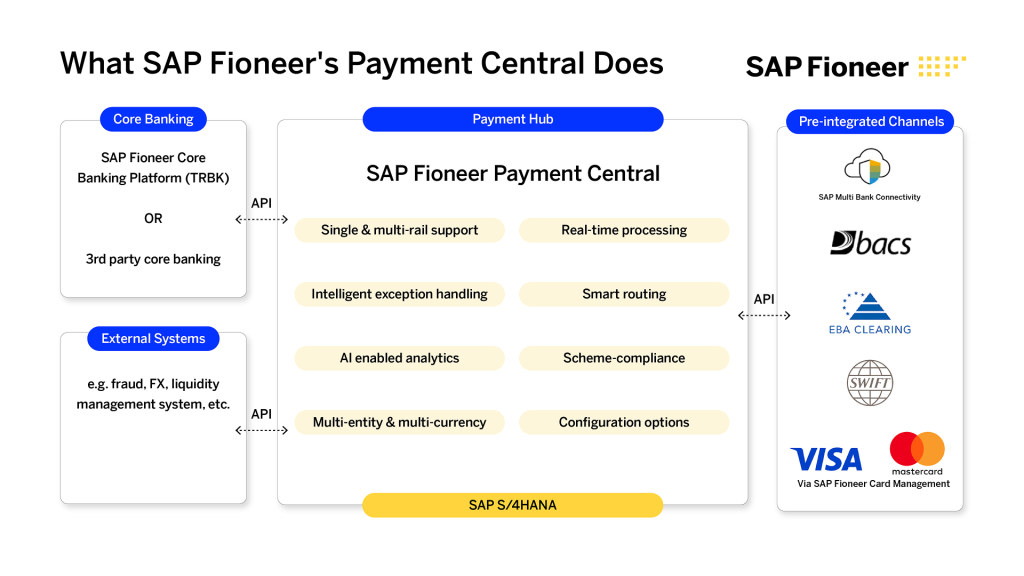
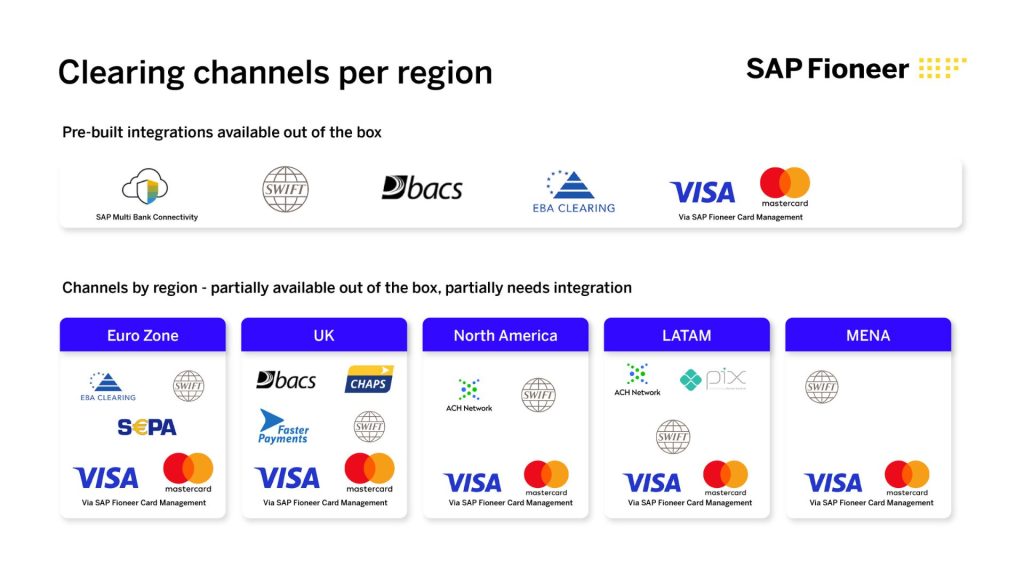
With built-in access to multiple real-time payment schemes worldwide, banks can quickly join new networks and expand reach without rebuilding from scratch. Flexible APIs also make it easy to connect Payment Central to core banking systems (whether SAP Fioneer’s or third-party) and external systems for fraud detection, FX, liquidity management, and more.
At the same time, Payment Central’s orchestration capabilities make it a trusted foundation for emerging payment innovations – from stablecoins and central bank digital currencies (CBDCs) to blockchain-based settlement models. Banks can experiment and integrate these new forms of value transfer alongside traditional payment rails, all within a unified and compliant architecture. This ensures they can evolve with the payments landscape without adding complexity or compromising control.
Maintain compliance and stay future-ready with built-in standards
Compliance shouldn’t slow modernization – it should be an enabler. With Payment Central, banks can operate on a future-ready, fully compliant foundation that automatically adapts to evolving payment standards and regulatory requirements.
The highly robust platform comes with major global standards built in, including ISO 20022, SWIFT MT, and ISO 8583. This means banks can support anything from high-value cross-border payments to card-based transactions, without constant manual updates or system overhauls.
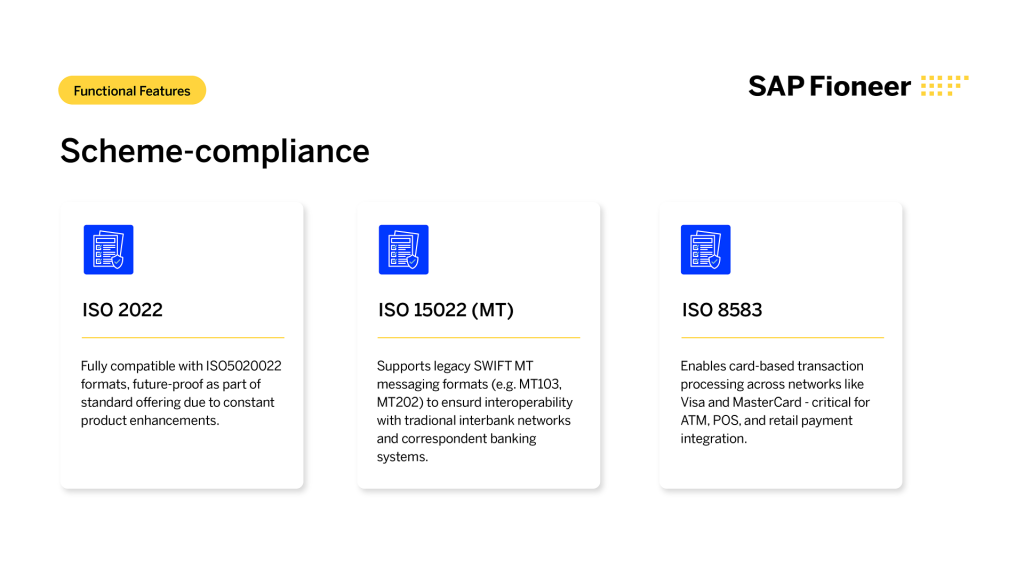
With compliance built in, Payment Central reduces operational risk and regulatory overhead. This frees teams to focus on innovation and customer experience rather than the next impending update.
Detect security risks and resolve errors quickly with real-time monitoring and transaction analysis
One of the biggest challenges with real-time payments is the increased risk of fraud. Transactions settle instantly, leaving little time to catch suspicious activity or errors that would’ve previously been identified and reversed.
In this always-on payments environment, real-time visibility and control are essential. Payment Central gives banks complete oversight of every transaction as it happens, helping them detect issues early, respond faster, and maintain smooth operations around the clock.
Because the system operates 24/7 without batch windows, banks can monitor payments and check for potential security risks at any time. Through a central Fiori-based view, configurable monitoring and alerting provide operations teams with real-time insights into system performance, transaction flows, and risk events.
Payment operations teams also benefit from an interactive operational control dashboard, where they can track the status of individual payments, detect bottlenecks, and collaborate on issue resolution directly within core workflows.
In addition, Payment Central can integrate any additional fraud prevention or detection tool directly into its real-time processing layer through open APIs and flexible architecture. This includes connecting to market-leading fraud detection platforms, as well as specialized tools for card transaction monitoring, behavioral analytics, and anomaly detection.
Together, these features give banks full situational awareness and control, enabling them to manage risk proactively and deliver a frictionless real-time payment experience, even as transactions move faster than ever.
How a UK retail bank vastly reduced disruptions for 3 billion annual transactions with Payment Central
A UK retail bank faced serious challenges with batch payments because of a complex, costly, and ageing payments landscape built around a 1980s mainframe. Payment delays and system faults were common and led to operational risk and customer dissatisfaction.
The bank’s solution was to implement SAP Fioneer’s Payment Central for high-volume batch processing across Bacs and Visa schemes, handling nearly 3 billion transactions annually. SAP Fioneer engineers delivered a new standard solution for Bacs in just six months, from requirements gathering to full software deployment.
With Payment Central in place, the bank eliminated the constant disruptions caused by legacy systems. Staff can now focus on developing the business, while customers receive their payments on time and gain access to payment information on demand.
Quickly deliver always-on, real-time payments with a modern payment hub
Real-time payments have redefined what it means to be a modern bank. Yet, as we’ve seen, many institutions still grapple with legacy systems, fragmented payment rails, and batch-era processes that weren’t built for an always-on world. This creates operational risk, delayed insights, and limits the agility needed to compete in real time.
SAP Fioneer’s Payment Central is designed to overcome exactly these challenges. By consolidating fragmented systems into a single, resilient, and compliant payment hub, it enables banks to process instant payments seamlessly and ensure continuous availability across every rail.
The future of payments is instant, and with Payment Central, your bank can be too. Request a demo today.

Related posts

Wie KI die Effizienz im Zahlungsverkehr neu definiert

ISO 20022 – The decade-old standard banks still aren’t ready for

Cross-border payments without borders: from SWIFT to emerging rails
Most read posts

What sets modern policy administration systems apart

The risk of staying stagnant: How corporate banks are stepping up in cash management with virtual account solutions

Virtual account management: the quick win for a stronger cash management proposition
More posts
Get up to speed with the latest insights and find the information you need to help you succeed.